Format record · Two products sold under one word · Read 2026-09-14
Taxi top or Taxi TV: which New York audience are you buying?
A taxi top is seen from the street: pedestrians and drivers around the 8,878 yellow taxis on the road on an average day (NYC TLC, May 2026). Taxi TV is seen from the back seat: the passengers on 127,319 yellow trips a day, for an average ride of 17.5 minutes. They are counted, regulated and sold by different people.
This page compares the two products structurally: who sees each, how each is counted, what the TLC rulebook allows on each, who sells each, and what is published for each. It does not recommend one. Fleet and trip figures are from the TLC record; every rate is on the cost page with its publisher and date.
Who sees a taxi top?
People outside the cab: the sidewalk at a crossing, the car behind at a light. The roof is the exterior surface with its own authorization rule in the TLC rulebook.
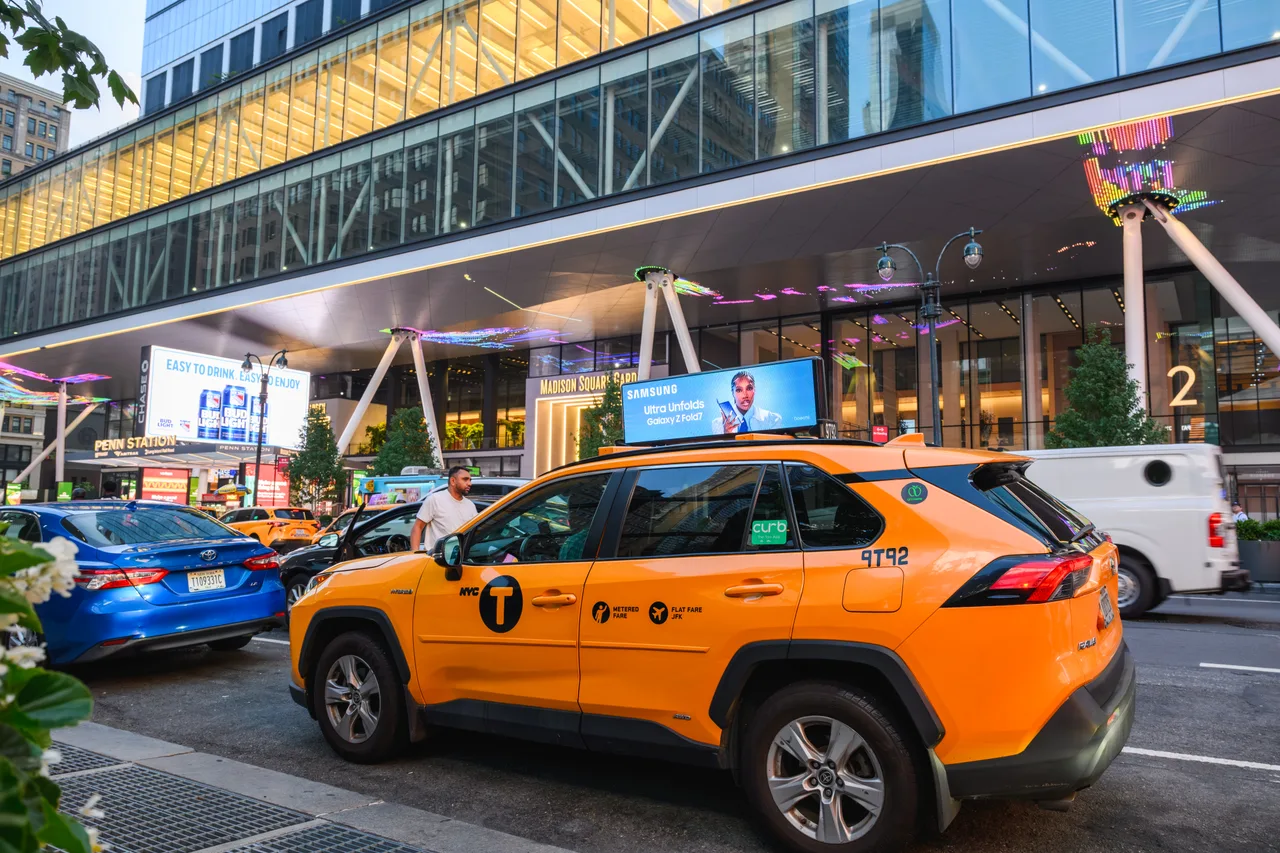
Samsung · Digital top · Madison Square Garden, Penn District · 2025
The frame above is a digital top on medallion 9T92 outside Madison Square Garden. Read it the way the street reads it: from the side, at roof height, for the seconds the cab is stopped or passing. That is the whole product. A static top holds one message day and night; a digital top rotates several advertisers and can change by hour and location, which means the number of cabs you buy is not the number of minutes your creative is up. The campaign archive shows both, photographed on the street rather than rendered.
How a roof unit is counted
Against traffic, not against riders. Geopath, the out-of-home measurement body, lists taxi panels under transit displays and defines an impression as the number of times people passing a display are likely to notice the ad, reported in weekly increments; it states that circulation, the old count of people with an opportunity to see, is no longer a credible measure of an audience and is not endorsed as a buying currency. Blue Line Media's footer credits Geopath audience location measurement data. Its New York page nonetheless prints a round 10,900 impressions per taxi per day with no method, and its national page prints 9,000 to 12,000 for a static top against 1,000 to 5,000 for a digital top, so the unit that costs more is stated to be noticed less (read 2026-09-14).
The honest denominator is the fleet on the road: 8,878 yellow taxis per day, each working 8.5 hours a day and 26.6 days a month (NYC TLC monthly indicators, May 2026). Not the 13,589 medallions on the books, 4,711 of which are not on the street on a given day. Any impression figure a seller gives you should be built on the first number, and the seller should be able to say which of those cabs, in which neighbourhoods, for how many hours.
Who sees Taxi TV?
One person, or a few, in the back seat, for the length of the ride. A different audience from every other taxi format, and counted a different way.
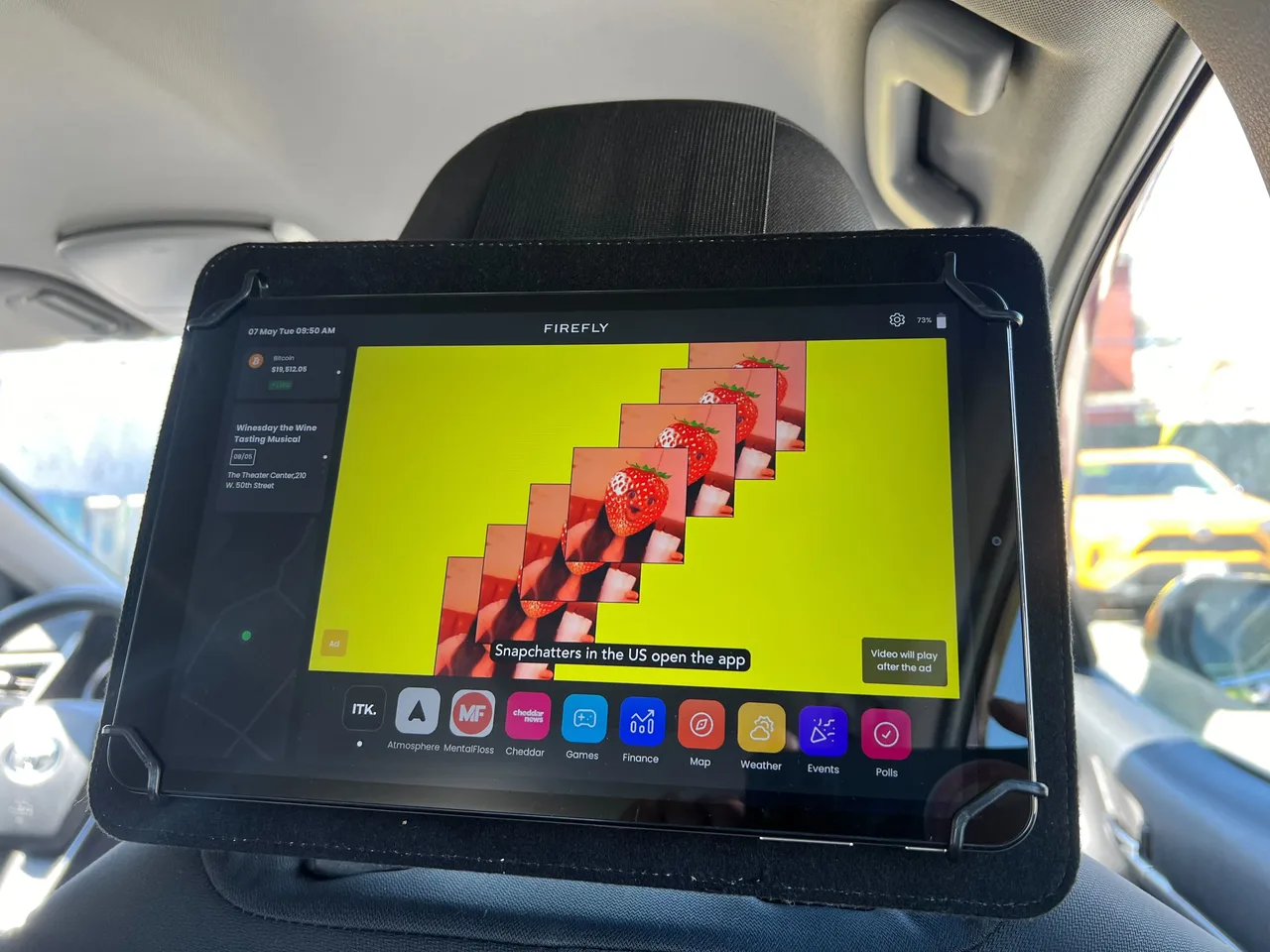
Snapchat · In-car screen · Inside a New York cab
The frame above is the passenger screen in a New York cab, a Snapchat spot playing on a tablet mounted on the back of the front seat, with the meter, a map and news panels around it. The person watching has already chosen to get in. What the rulebook calls this screen is a Passenger Information Monitor: it must sit in the back-seat area with an unobstructed view from the rear seat, be a touch screen between 10 and 15.5 inches measured diagonally, have audio, and process the fare (35 RCNY 75-25(d)(1), read 2026-09-14). The passenger may control the volume, mute it after the TLC prologue, and turn the screen off, though it comes back on when the meter stops to take payment (75-25(d)(1)(v) and (vi)).
How a passenger screen is counted
Against trips. The TLC recorded 127,319 yellow trips per day in May 2026, about 3,946,889 in the month (127,319 × 31 days), with an average trip of 17.5 minutes (NYC TLC monthly indicators). That is the ceiling on rides in front of a screen; it is not a count of people, because a trip can carry more than one passenger, and it is not a count of views, because the screen can be off. Vendors publish their own network figures without a New York breakdown or a method: Curb states 15K+ screens, 2.2B+ impressions annually and 65+ major markets on its Taxi TV page; CMT states 5,600 passenger-facing screens across 10 U.S. markets in a September 2025 partnership announcement and describes a 12 to 14 minute taxi trip on its media page, three and a half to five and a half minutes shorter than the TLC average. CMT also states that its program only plays when passengers opt to watch and that price is on a per-ad basis, capped at the contracted number of ads.
What does the TLC rulebook allow on each?
Read in the current rulebook PDFs on 2026-09-14. Chapter 67 governs the roof of a yellow medallion taxi, Chapter 75 the screen inside it, Chapter 59 the for-hire vehicles that are neither.
| Constraint | Taxi top (35 RCNY 67-16) | Taxi TV screen (35 RCNY 75-25(d)) |
|---|---|---|
| What it is in the rule | A Rooftop Advertising Fixture: a device that incorporates the functions of a roof light with the displaying of advertising (67-03(b)). | A Passenger Information Monitor, part of the Technology System every taxicab must have from a licensed provider (67-15, 75-25(d)). |
| Who may install or run it | A medallion owner, after paying an annual advertising permit fee, may install an authorized fixture (67-16(a)); the fixture design needs TLC approval and MIL-STD 810f certification by a professional engineer (67-16(c)). | The TPEP provider may display commercial advertising and sponsorships on the PIM (75-25(d)(2)(iv)), and must then also carry reasonably fresh news and entertainment content (75-25(d)(2)(v)). |
| Shape and size | Two-sided, each side longer across than high, not necessarily a rectangle; advertising to the sides of the vehicle only, not to the front and back (67-16(c)(4)). Creative may not exceed the display surface, with a 100 square inch exception if the engineer certifies it (67-16(c)(3)). | Touch screen, interactive, full colour, with audio; not more than 15.5 inches and not less than 10 inches diagonally, back-seat area, unobstructed from the rear seat (75-25(d)(1)(i) and (iii)). |
| Viewer control | None. The street cannot switch a roof off. | Passenger controls the volume and may mute after the prologue; passenger may turn the screen off, and it comes back on when the meter disengages (75-25(d)(1)(v) and (vi)). |
| Content limits | Advertisements must be current: an event ad stays current until 60 days after the event; nothing offensive to public morals or in violation of Penal Law 245.11, removed within 15 days of a TLC request (67-16(d)). | No implied City endorsement without written consent (75-25(d)(3)); a list of prohibited categories, beginning with unlawful goods and services (75-25(d)(4)). |
| Uber, Lyft and other for-hire vehicles | The Commission will not approve exterior advertising on a For-Hire Vehicle that consists in whole or in part of roof top advertising (59A-29(e)(2)). | Interior advertising in a For-Hire Vehicle only through an Interior Advertising Provider licensed under Sub-Chapter 59E (59A-29(e)(3)). |
One more line from the rulebook applies to neither column but comes up in every proposal. 35 RCNY 58-32(c): an owner must not display any advertising on the exterior of a taxicab unless authorized by the Commission. Rooftop fixtures are; body wraps on a yellow cab are not a standard authorized format, so a "taxi wrap" row on a rate card describes for-hire, rideshare or branded fleet vehicles in this market. The rule is recorded next to the wrap rows on the cost page.
Who sells each?
Operators own or run the hardware; resellers quote it. Each name below had a live New York page showing the product on 2026-09-14. The full roster, with what each controls, is on the companies page.
| Seller | Taxi tops | Taxi TV / in-car screens | Publishes a rate card? |
|---|---|---|---|
| SOMO | Operator: 4,000 digital displays across 2,000 yellow taxis, as it states | Sells CMT's TaxiTV screens alongside its tops under a partnership announced September 2025 | No |
| CMT | No | Operator: in-taxi video network on its 10.4-inch screens; a TLC technology provider | No; per-ad pricing, on request |
| Curb | No | Operator: Curb Taxi TV, sold direct and programmatically through Place Exchange and Vistar, as it states | No |
| NY Taxi Ads | Operator: describes itself as the largest digital taxi-top network in New York, no fleet count published | No product page | General estimates in a blog guide |
| Firefly | Operator: GPS-enabled digital tops and static tops, New York among 15 listed markets, no New York fleet count published | Lists TaxiTV among its products | No |
| Blue Line Media, DASH TWO, AdQuick, Inspiria Outdoor | Resell or quote both; Blue Line states it is not the owner or exclusive provider of the formats it lists | Resell or quote fleet spots and per-screen buys | Blue Line: rate card. Others: estimates |
What is published for each, and in what unit?
The unit is the difference. A roof is priced per cab per period; a screen is priced per screen or as a spot across the whole fleet. The full table, every publisher, is on the cost page.
| Product | Unit as published | Lowest published | Highest published | Publishers |
|---|---|---|---|---|
| Static taxi top | Per cab, four-week period | $100 – $200 | $500 – $1,000 | OOH Today low, Alluvit Media high; Blue Line Media New York $300 – $500 |
| Digital taxi top | Per cab, four-week period | $120 – $180 | $300 – $800 | OOH Today low, Alluvit Media high; Blue Line Media New York $400 – $600 |
| In-car screen | Per screen, 1,000-screen minimum | about $30 | about $30 | DASH TWO, OOH Today, AdQuick agree; BillboardsIn lists $5,000 to $20,000 per month for seat-back screens without a count |
| Taxi TV spot, whole New York fleet | Per spot length, four-week period | $10,000 – $30,000 (:15) | $18,000 – $65,000 (:60) | Blue Line Media New York page; its national page prints lower floors for the same spots |
All figures read 2026-09-14; none is a quote and none is attributed to any operator. Every row with its publisher, type and date, and the multi-cab arithmetic against the 8,878 cabs on the road, is on the cost page.
What does each format let you say?
| Creative constraint | Taxi top | Taxi TV screen |
|---|---|---|
| Canvas | Static: 48 inches wide by 14 inches high, per Blue Line Media's spec table. Digital: 560 by 160 pixels, with a 1920 by 674 file added for New York, per the same table. | 1920 by 1080 pixels per Blue Line Media's spec table; CMT states 10.4-inch screens with a companion static banner beside every video ad. |
| Duration | Static: the whole period, no rotation. Digital: up to 8 seconds per creative in Blue Line's spec, rotated with other advertisers. | Up to 30 seconds, 60 may be accepted, per Blue Line's spec; Blue Line's New York rates are priced at :15, :30 and :60. |
| Sound | None. | Yes, under passenger control (75-25(d)(1)(v)). |
| Interaction | None on the unit; a QR code is read from the sidewalk at best. | Touch screen by rule; Curb and CMT both state companion banners and QR codes. |
| Lead time | Static print two to three weeks before start, digital three business days, per Blue Line Media. | CMT states turnaround can be under two hours from receipt of creative. |
The specs are the resellers' and the operators' own statements, read 2026-09-14; the operator that runs your cabs or screens will send its own template, and that template governs. Send the brief with dates and the audience named, and the format answer follows from it.
Frequently asked questions
- What is Taxi TV advertising?
- Taxi TV is the trade name for video advertising on the passenger-facing screen inside a New York yellow cab. In the TLC rulebook that screen is the Passenger Information Monitor, part of the Technology System every taxicab must carry (35 RCNY 67-15), and 35 RCNY 75-25(d)(2)(iv) allows the technology provider to display commercial advertising on it. The two providers in New York cabs are CMT and Curb; they and their resellers sell the spots, usually as a share of the whole fleet rather than per cab.
- How many people see a taxi top in New York each day?
- No city dataset says. The TLC publishes 8,878 yellow taxis on the road per day, 8.5 hours each (NYC TLC monthly indicators, May 2026); that is the number of roofs, not of eyes. Vendor figures for eyes are published without a method: Blue Line Media states 10,900 impressions per taxi per day on its New York page and 9,000 to 12,000 for a static top against 1,000 to 5,000 for a digital top on its national page (read 2026-09-14). Geopath, the OOH measurement body, defines an impression as a person likely to notice the ad, reported weekly, and no longer treats raw circulation as a currency.
- How long does a passenger sit in front of a Taxi TV screen?
- The average yellow-taxi trip in May 2026 was 17.5 minutes (NYC TLC monthly indicators), which is the honest dwell figure. Vendors publish shorter and wider numbers: CMT describes a 12 to 14 minute taxi trip on its media page, and Alluvit Media and AdQuick both say 10 to 30 minutes. The rulebook also lets the passenger mute the screen and turn it off (35 RCNY 75-25(d)(1)(v) and (vi)), so ride length is a ceiling on exposure, not a measure of it.
- Can passengers turn Taxi TV off?
- Yes. 35 RCNY 75-25(d)(1)(vi) says the Passenger Information Monitor may be turned off by the passenger, provided required content such as the prologue, epilogue and fare notifications stays visible, and the screen must come back on when the meter disengages to process payment. The volume must be passenger-controllable and may be muted after the prologue (75-25(d)(1)(v)). Ask any Taxi TV seller how it counts a play on a screen that has been switched off.
- Can I advertise on the roof or inside an Uber or Lyft in New York?
- Not on the roof. 35 RCNY 59A-29(e)(2) says the Commission will not approve any exterior advertising on a For-Hire Vehicle that consists in whole or in part of roof top advertising. Inside, 59A-29(e)(3) allows interior advertising only through an Interior Advertising Provider licensed under Sub-Chapter 59E. Rooftop fixtures are a yellow-medallion format under 35 RCNY 67-16, which is why every roof figure on this site is counted against the 8,878 yellow taxis on the road, not against the 62,526 high-volume for-hire vehicles.
- Is a taxi top or Taxi TV better for a New York campaign?
- They are different products, not a better and a worse one. A roof unit reaches people outside the cab, is counted against street traffic, and is priced per cab per four-week period (published ranges $100 – $200 to $500 – $1,000 for a static top). Taxi TV reaches the rider already inside, is counted against trips, and is priced as fleet-wide spots or per screen (Blue Line Media publishes $10,000 – $30,000 for a :15 spot across the New York fleet). A brief that names the audience answers the question; one that names the vehicle does not.
Sources read for this page
- 35 RCNY Chapter 67, Rules for Taxicab Hack-up and Maintenance, TLC rulebook PDF updated October 24, 2025 · 67-03(b), 67-15, 67-16 · read 2026-09-14
- 35 RCNY Chapter 75, Taxicab Technology Service Providers, TLC rulebook PDF · 75-25(d) Passenger Information Monitor · read 2026-09-14
- 35 RCNY Chapter 59, For-Hire Vehicles, TLC rulebook PDF updated February 27, 2026 · 59A-29(e) · read 2026-09-14
- 35 RCNY Chapter 58, Medallion Taxicab Owners, TLC rulebook PDF · 58-32(c) · read 2026-09-14
- NYC TLC monthly indicators CSV · vehicles per day, trips per day, hours, days and minutes per trip, May 2026 · read 2026-09-14
- NYC TLC 2025 Annual Report · medallions authorized · read 2026-09-14
- Geopath glossary · impressions, circulation, transit displays · read 2026-09-14
- Blue Line Media, NYC Taxi Ads and national taxi page · rates, impressions claims, specs · read 2026-09-14
- Curb, Advertise on Taxi TV · network claims · read 2026-09-14
- CMT Media Network and SOMO and CMT partnership announcement, DPAA, September 3, 2025 · read 2026-09-14
- SOMO, Products and Solutions · read 2026-09-14
- Alluvit Media, AdQuick, DASH TWO, OOH Today · ride-length and per-screen claims · read 2026-09-14
What to send us
- Boroughs or corridors
- Dates or flight length
- Budget band
- The metric you will judge it by
A person replies with the published ranges for those dates and which sellers hold the inventory. This site publishes no rate card; every figure on it is a third-party published number, dated.
Send the brief